
Why JD Edwards Needs an AI Copilot to Work Smarter

Oussama Nait-Zlay
Content Marketing Manager
January 20, 2026
JD Edwards runs some of the most important operations in manufacturing and distribution. Orders. Inventory. Procurement. Maintenance. The system does what it’s supposed to do, and it does it well.
Yet if you look closely, something else is always happening alongside it.
Emails pile up. PDFs arrive in inboxes. Teams forward messages with notes like “Can you check this?” or “Does this look right?” A customer asks where their order is. A supplier sends an invoice that almost matches the purchase order, but not quite.
None of that chaos lives neatly inside JD Edwards.
So people step in. Analysts interpret. Clerks retype. Developers explain how things work because the documentation hasn’t kept up. Slowly, quietly, human effort becomes the glue holding structured systems together.
That work is invisible on project plans, but everyone feels it.
It shows up as delays. As frustration. As risk during audits or upgrades. And as a growing dependency on a few key people who “just know how it works.”
JD Edwards isn’t the problem here. The gap is. The gap between a very structured ERP and a very unstructured business reality.
And that gap is exactly where most automation efforts start to crack.
TL;DR
-
JD Edwards remains the system of record, but much of the operational complexity happens before data ever reaches the ERP.
-
AgentHub acts as an AI copilot that helps interpret unstructured information and prepare it securely for JD Edwards, while Orchestrator and existing integrations continue to execute transactions and enforce business rules without being bypassed.
-
AI agents deliver the most value where context and exceptions slow teams down, while traditional automation remains the better choice for fully structured processes.
-
Era Consulting Group’s approach focuses on pragmatic, governed, and human-centered adoption, reducing friction without compromising control.
Why JD Edwards is powerful, and still struggles with the real world
JD Edwards is built for structure. That’s its strength.
Every field has a purpose. Every process follows defined rules. Every transaction expects clean, validated data. When information arrives the way the system expects it, things run smoothly. Fast, even.
But business rarely behaves that way.
Suppliers don’t follow templates. Customers don’t speak in item numbers. Emails come with half the details missing, or too many details mixed together. Files look different depending on who sent them. And people, well, people explain things the way people do.
JD Edwards doesn’t read between the lines. It isn’t supposed to.
That’s not a flaw. It’s a design choice. ERPs are systems of record, not systems of interpretation. They need certainty, not guesswork. So when the input is fuzzy, humans step in to translate reality into something the system can accept.
Here’s where the tension shows up.
Teams end up spending a surprising amount of time doing work that feels… unnecessary. Copying data. Double-checking fields. Asking clarifying questions. Explaining how a process works because the documentation hasn’t kept pace with years of changes.
And when organizations try to automate this gap, they often hit a wall.
Traditional automation works great when everything is predictable. If this field equals that value, then do the thing. But the moment something changes slightly, a new invoice layout, a different wording in an email, an exception that wasn’t planned for, the automation stalls or breaks.
So people go back to manual work. Or worse, they stop trusting automation altogether.
This is the quiet limitation of even the best ERP environments. Not because the system is lacking, but because the world feeding it is messy, inconsistent, and human.
Which raises an important question.
If JD Edwards is excellent at executing rules, what handles the interpretation that happens before those rules can even apply?
That’s where the story really starts to shift.
Meet AgentHub: the AI copilot built to work alongside JD Edwards
So if JD Edwards is doing exactly what it was designed to do, and the real friction lives before data ever reaches the ERP, the next question is almost obvious.
What takes care of that translation work?
This is where AgentHub comes in. Not as a replacement. Not as a shiny layer slapped on top of your ERP. And definitely not as a generic chatbot with access it shouldn’t have.
AgentHub was built to play a very specific role. It acts as an operational copilot that sits between messy, real-world inputs and the structured logic of JDE.
Think of it less like automation and more like assistance.
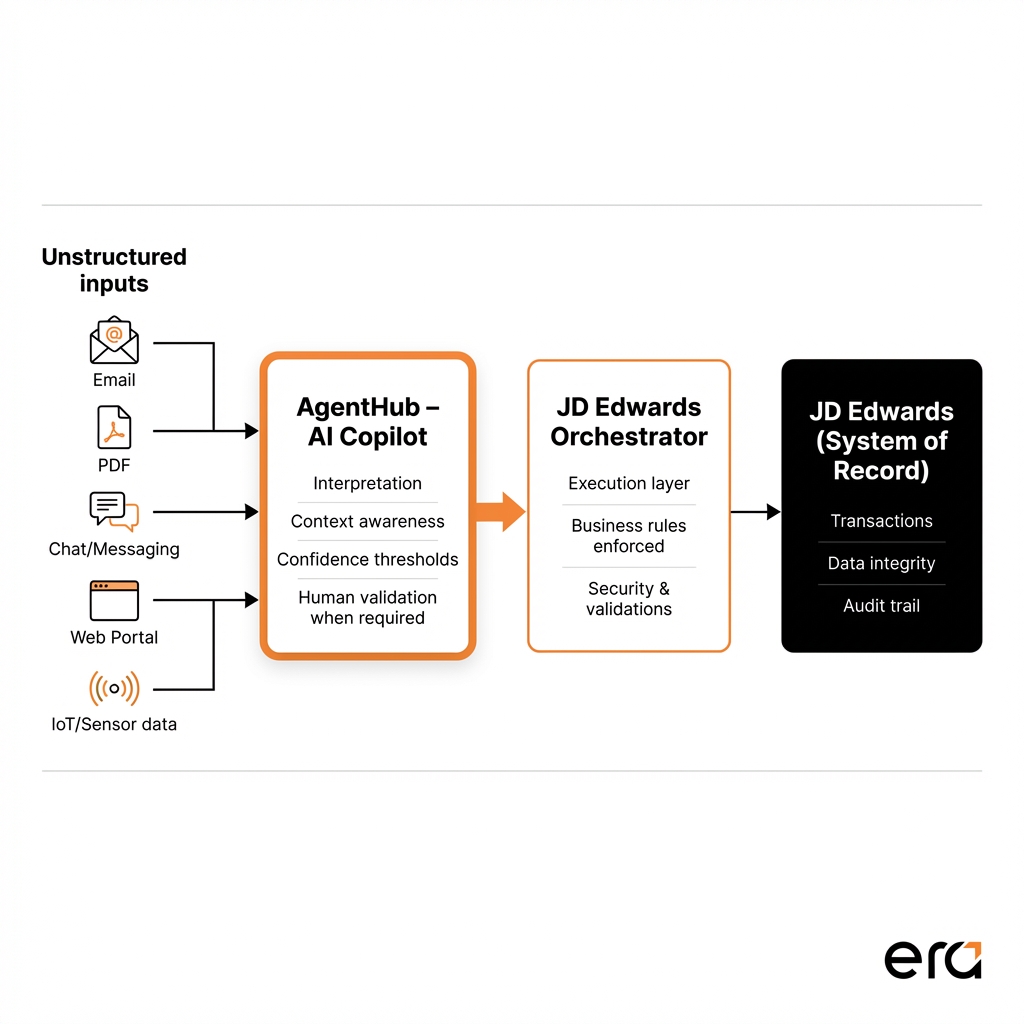
AgentHub reads. It interprets. It checks context. It asks questions when something doesn’t add up. And only when the information is clear and validated does it pass structured data forward to JD Edwards through the proper channels.
Here’s the important part. AgentHub doesn’t “do” transactions on its own.
It doesn’t create orders behind the scenes or update records directly. Instead, it prepares information the same way a human would, then hands it off to JD Edwards using approved services and business rules. The ERP stays firmly in control.
That distinction matters more than it sounds.
A lot of AI tools promise intelligence but ignore context. They don’t understand how your JD Edwards environment is configured, what naming conventions you use, or which rules are non-negotiable. AgentHub was created specifically to close that context gap.
It’s aware of your data structures. It respects your processes. And it operates with guardrails by design.
Another way to think about it?
AgentHub doesn’t replace people either.
It takes on the repetitive, mentally draining work that usually sits between an email and a transaction. The reading. The extracting. The double-checking. The “does this make sense?” part. Humans stay involved where judgment, approval, or accountability is required.
That balance is intentional.
Because the goal here isn’t autonomy for the sake of autonomy. It’s clarity. Speed. And fewer unnecessary handoffs before work actually gets done.
And this is where AgentHub starts to feel less like an AI experiment and more like a practical extension of how JD Edwards already works.
The safe bridge: how AgentHub works through Orchestrator, not around it
This is usually where IT leaders lean in a little closer.
Because once artificial intelligence enters the conversation, the first concern isn’t speed or convenience. It’s control. Who touches the data? What happens if something goes wrong? And how do we make sure the ERP doesn’t turn into a black box?
AgentHub answers those questions by design.
Instead of writing directly into JD Edwards, AgentHub always works through Orchestrator and standard services. That’s not a technical preference. It’s a rule. A hard one.
In practical terms, this means the ERP remains the system of record. Business rules still apply. Security models still apply. If JD Edwards wouldn’t accept a transaction from a human user, it won’t accept it from an AI agent either.
And that changes the conversation entirely.
AgentHub can read an email, interpret a request, and prepare structured data. But when it’s time to act, it hands that data to Orchestrator, just like any other integration or user-driven process would. JD Edwards validates it. Or rejects it.
If something doesn’t line up, say an item doesn’t exist, or a customer number is wrong, JDE says no. AgentHub captures that response and routes it back for correction or human review.
That feedback loop is intentional. It keeps the system predictable.
There’s another layer here that matters just as much. Confidence thresholds.
AgentHub isn’t forced to pretend it’s certain when it’s not. If the information it’s reading is unclear or incomplete, it pauses. It asks for validation. It routes the task to a person before anything reaches the ERP.
From an audit and governance perspective, this is huge.
Every action still results in a traceable transaction inside JD Edwards. Every step can be logged. Every update can be attributed to a system user, just like any other automated process.
So instead of introducing risk, AgentHub actually reduces it. Fewer manual re-entries. Fewer misunderstood requests. Fewer last-minute surprises during audits or upgrades.
Next, we’ll look at where this kind of intelligence truly shines, and just as important, where it shouldn’t be used at all.
Want to see how Orchestrator fits into modern JD Edwards architectures?
This on-demand session walks through practical modernization scenarios using Orchestrator and integrated capabilities, including AI.
Watch the webinarWhere AI agents shine, and where they really shouldn’t
This is where things get a bit counterintuitive.
AI agents like those built in AgentHub are incredibly useful. But they’re not meant to sit everywhere. And pretending otherwise is usually how projects go sideways.
They shine when interpretation is required.
Think about the moments before a transaction happens. An email that sounds like an order but isn’t clearly one. An invoice that almost matches the purchase order, except for a small discrepancy. A customer message that mixes frustration, questions, and actual requests into one paragraph.
Humans are good at reading that mess. Traditional automation isn’t. AI agents sit somewhere in between. They can read context, extract intent, and prepare clean, structured information that systems like JD Edwards can actually work with.
That’s their sweet spot.
They’re also strong when exceptions are the norm, not the edge case. When layouts change. When wording varies. When the process is the same, but the input never looks identical twice.
Now here’s the important flip side.
AI agents are not a replacement for high-volume, purely transactional processing. If you’re running a nightly batch update, syncing inventory counts from a warehouse system, or posting thousands of identical records where no judgment is required, classic automation and Orchestrator are still the right tools.
And that’s okay.
In fact, it’s healthy. Because it keeps each component doing what it does best.
AgentHub handles the messy front end. Orchestrator executes the structured back end. JD Edwards remains the authority that enforces rules, security, and consistency.
There’s another boundary worth mentioning. Decision ownership.
AgentHub doesn’t sign off on large financial commitments. It doesn’t change pricing strategies. It doesn’t decide what the business should do. It prepares information, suggests actions, and routes tasks. Humans stay accountable for the final call where it matters.
That balance often feels slower on paper. In practice, it’s faster. Fewer reworks. Fewer escalations. Less time spent fixing something that should have been right the first time.
So instead of asking, “Where can we use AI everywhere?” the better question becomes, “Where does interpretation slow us down today?”
That’s usually where AI agents earn their keep.
One concrete example: bringing clarity to JD Edwards code and processes
If there’s one area where the gap between people and systems really shows up, it’s here.
Over time, JD Edwards environments grow dense. Custom logic gets added. Processes evolve. Developers move on. Documentation exists, but it’s often outdated, scattered, or locked in someone’s head. When a change is needed, or an audit is coming up, teams scramble to understand what actually happens behind the scenes.
This is where one of the most practical AgentHub use cases comes into play.
Inside the AgentHub ecosystem, there are specialized agents designed to work directly with live JD Edwards metadata. Not to change it, but to interpret it. They read how programs, workflows, and configurations behave today, not how they were supposed to behave years ago.
The result feels almost disarming in its simplicity.
Instead of digging through code or relying on hallway conversations, teams get clear visual process flows. Documentation that explains logic in plain language. Test scenarios that reflect real security models and configurations, not assumptions.
This approach is already in use today through Era’s AI-powered JD Edwards analysis capabilities, outlined in our overview brochure.
You know what? For many teams, this is about confidence.
Confidence that everyone is looking at the same reality. Confidence that a change won’t break something unexpected. Confidence that audits, upgrades, or handovers won’t turn into high-stress events.
And importantly, this isn’t a one-time snapshot.
Because these agents work from live metadata, the outputs stay current. When the system changes, the understanding changes with it. No manual rewrites or long catch-up cycles.
This example matters because it shows what AgentHub is really about, which is removing friction where understanding slows everything else down.
And the same principle applies beyond code and documentation.
Which brings us to the operational side, where AI agents start helping teams outside IT just as much as inside it.
How this shows up in day-to-day operations
Once you see AgentHub working in technical scenarios, it becomes easier to spot where the same pattern applies elsewhere.
Operations are full of small interruptions. Constant context switching. Someone asks for an update. Someone sends information that’s almost complete. Someone needs an answer that technically lives in JD Edwards, but isn’t easy to retrieve or explain quickly.
This is where AI agents start to feel genuinely helpful.
Take customer service. A simple question like “Where is my order?” often triggers several steps behind the scenes. Identify the customer. Find the order. Check its status. Translate that status into a response a human would actually understand. Most of that work isn’t complex, but it is repetitive and time-consuming.
An AgentHub-powered assistant can handle the lookup and the explanation, then draft a response that a human reviews and sends. The ERP stays protected. The customer gets a faster answer. And support teams spend less time chasing information.
Procurement and accounts payable follow a similar pattern.
Invoices arrive as PDFs. They reference purchase orders inconsistently. Amounts match most of the time, but not always. Instead of manually opening documents and cross-checking fields, an AI agent can read the invoice, compare it against JD Edwards data through Orchestrator, and flag only the exceptions that need attention.
Even maintenance teams benefit from this approach. Signals from equipment or external systems can be interpreted, matched against existing records, and turned into structured requests. When something needs action, JD Edwards still decides how that work order is created and tracked.
Across all these examples, the pattern stays the same.
AgentHub handles interpretation. Orchestrator executes. JD Edwards remains the source of truth.
And maybe that’s the most important takeaway.
This isn’t about automating everything, but more about reducing the quiet friction that slows teams down every day, without asking them to give up control or trust.
To make that work long term, though, there’s one last piece that often gets overlooked. Governance. How AI is introduced, managed, and kept useful over time.
That’s where Era Consulting Group’s approach makes a real difference.
Why Era Consulting Group keeps AI practical, not chaotic
AI doesn’t usually fail because of technology.
It fails because it gets introduced without structure.
Too many tools. Too many experiments. Not enough clarity on ownership, limits, or long-term impact. In ERP environments especially, that kind of chaos is the last thing anyone wants.
This is where Era Consulting Group’s approach stands apart.
AgentHub wasn’t created as a playground for ideas. It was built as an operational framework, shaped by years of working inside real JD Edwards environments. The kind where small changes have big consequences, and where trust matters more than novelty.
Before an AI agent ever touches a live process, there’s intent behind it. What problem are we solving? Where does interpretation actually slow things down? What should stay human? What must remain fully controlled by the ERP?
That discipline carries through deployment as well.
Agents are introduced gradually. They work within existing rules. They evolve as the business evolves. And when JD Edwards configurations change, pricing logic, security models, workflows, the agents are adjusted to match. Not the other way around.
This is also why AgentHub fits so naturally into our broader methodology. AI isn’t treated as a feature. It’s treated as a capability that needs governance, monitoring, and care over time.
Or, put more simply.
Era Consulting Group doesn’t promise science fiction.
It delivers operational reality.
Small steps that remove friction. Clear boundaries that protect systems. And tools that help teams spend less time translating chaos, and more time moving work forward.
And that’s really what this is about.
JD Edwards remains the backbone. Orchestrator remains the gatekeeper. AgentHub becomes the missing layer that helps the two connect to the real world, calmly, safely, and with intention.
Modernizing JD Edwards Without Starting Over
If your JD Edwards environment works but feels harder to adapt than it should, this guide walks through practical ways to modernize step by step with AI and other innovative solutions. A clear path to evolve what you already rely on.
Download the free guideA final thought before you move on
If there’s one idea worth carrying forward, it’s this.
AI doesn’t need to replace your ERP to be useful. And JD Edwards doesn’t need to change what it is to benefit from intelligence.
The value sits in between.
When interpretation is handled thoughtfully, when execution stays governed, and when humans remain in the loop where it matters, AI stops feeling risky. It starts feeling obvious.
AgentHub was built for that space. Not to disrupt what already works, but to support it. To take on the messy, repetitive translation work that slows teams down and quietly drains energy, while leaving the system of record exactly where it belongs.
For organizations running JD Edwards, this is about removing friction in places that have been accepted for too long as “just the way it is.”
And sometimes, that’s the most meaningful kind of progress.
FAQ
Does AgentHub write directly into JD Edwards?
No. AgentHub never bypasses JD Edwards. All transactional actions go through Orchestrator or approved services, which means the ERP continues to enforce its business rules, validations, and security controls. If JD Edwards wouldn’t accept a transaction from a user, it won’t accept it from an AI agent either.
Is AgentHub replacing Orchestrator or existing integrations?
Not at all. Orchestrator remains the execution layer. AgentHub works alongside it by handling interpretation and preparation before data ever reaches the ERP. Think of AgentHub as helping decide what should happen, while Orchestrator controls how it happens inside JD Edwards.
Do we need to customize JD Edwards to use AgentHub?
No core customizations are required. AgentHub relies on standard Orchestrations and existing JD Edwards services. That keeps implementations lighter, easier to govern, and safer to maintain over time.
How is data security handled?
AgentHub operates through the same authentication and access controls used by JD Edwards integrations. External inputs are processed securely, and AI agents never have unrestricted access to ERP data. Every action can be traced back to a system user and logged for audit purposes.
Where does human validation still apply?
Human involvement is intentional. When information is unclear, incomplete, or sensitive, AgentHub routes tasks for review instead of guessing. For example, it can draft responses, prepare transactions, or flag discrepancies, but final approvals remain with people when required.
Is this approach suitable for every JD Edwards environment?
It works best in environments where unstructured inputs slow teams down, such as customer service, procurement, maintenance, or documentation-heavy processes. For high-volume, purely transactional batch jobs, traditional automation remains the better fit. The goal isn’t to use AI everywhere, but to use it where interpretation actually adds value.

Thinking about AI for JD Edwards, but want to stay grounded?
Every JD Edwards environment has its own history, constraints, and priorities. A short conversation with someone who understands both JDE and AI can help clarify what’s realistic, what’s not, and where small steps can actually make a difference.
Speak with a JD Edwards expert
Oussama Nait-Zlay
Content Marketing Manager
Oussama is a technology content expert at Era Consulting Group. He focuses on making complex topics related to ERP and enterprise technologies accessible, helping organizations fully leverage digital innovations. He brings several years of experience in the SaaS and technology industries, notably with companies such as Zoho and ManageEngine.
Follow Oussama Nait-Zlay
Featured