
AI in Business: The Real Challenge Might Not Be What You Think

Stephen Diamond
Senior Director, Technology
July 2, 2026
There's no escaping it. Artificial intelligence is everywhere. It's part of boardroom discussions, strategic planning sessions, software demonstrations and executive conversations. The promises are compelling: higher productivity, greater automation, better decision-making and improved customer experiences.
Yet one important reality often gets overlooked. When organizations talk about AI, they're not always talking about the same thing.
The term "AI" is frequently used as though it refers to a single technology capable of solving every business problem. In reality, it encompasses a broad range of technologies, each designed for different purposes and use cases. That misunderstanding often leads to unrealistic expectations. Some organizations expect a conversational AI assistant to generate accurate sales forecasts or replace advanced business analytics, even though that's not what it was designed to do.
Another common misconception is that AI will eventually replace ERP systems. In practice, the real challenge lies elsewhere. As organizations accelerate AI adoption, they also need to rethink how they manage data quality, information security, governance and the growing costs associated with these new technologies.
In other words, the challenge isn't just technological. It's organizational.
To understand why, we first need to recognize that AI isn't a single technology at all.
AI Isn't One Technology. It's a Family of Technologies.
Let's start with a simple example.
A company has three years of sales history stored in its CRM. The goal is straightforward: forecast demand for the coming months. Confident that AI has the answer, the team turns to an assistant like ChatGPT or Microsoft Copilot expecting accurate sales predictions.
Here's the problem: they're using the wrong type of AI.
This is one of the biggest misconceptions organizations face today. We often use the term "AI" as though it refers to a single technology, when in reality it encompasses a range of technologies designed to solve very different business problems.
Generative AI, popularized by tools such as ChatGPT, Microsoft Copilot and Claude, excels at creating content. It can draft emails, summarize documents, generate images, write code and answer questions in natural language.
Predicting future sales, detecting anomalies, anticipating equipment failures or optimizing inventory, however, requires a different approach. These use cases rely on predictive AI and machine learning models that analyze historical data to identify patterns and forecast future outcomes.
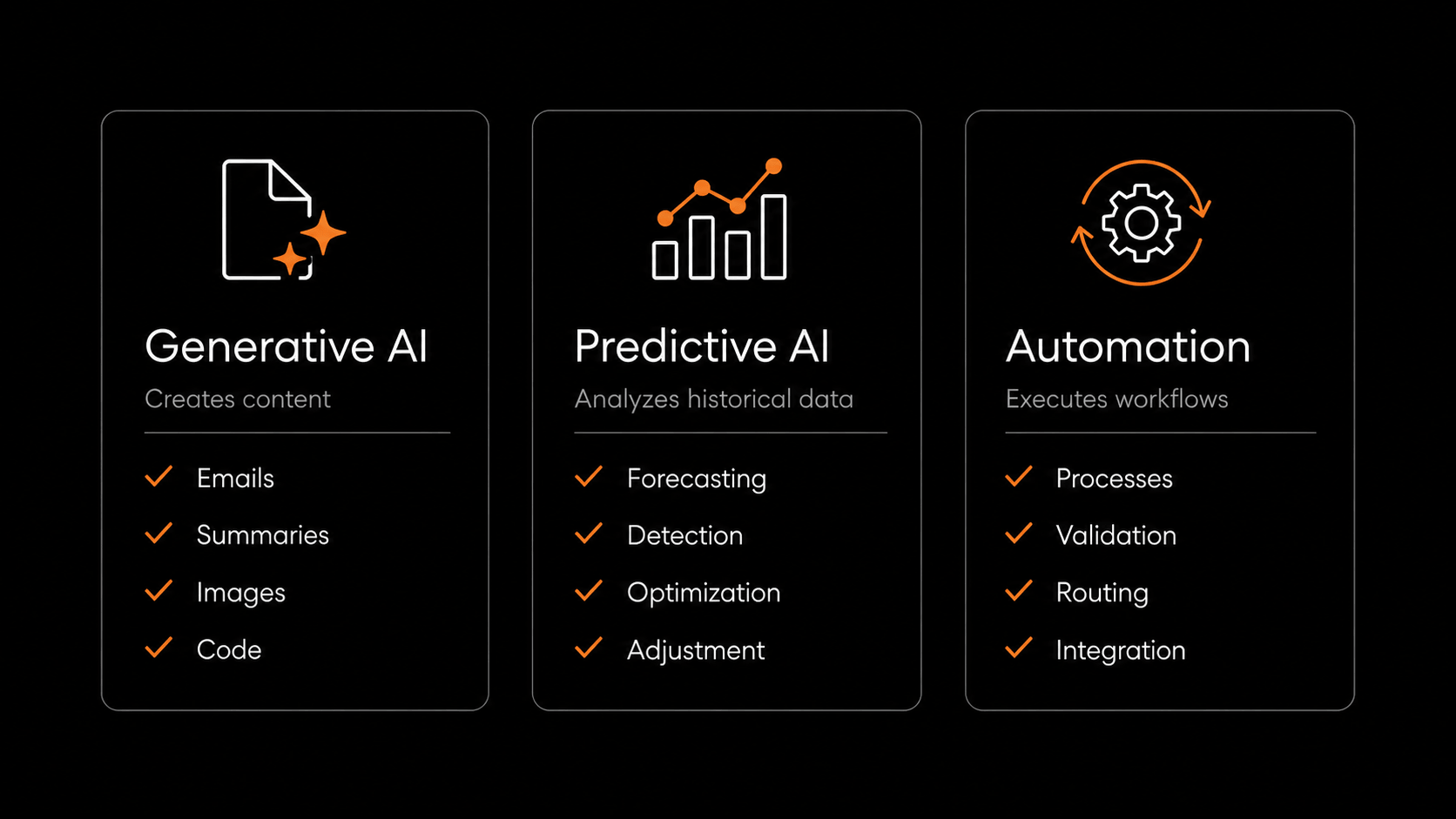
That distinction matters more than many organizations realize.
When businesses apply the wrong type of AI to the wrong problem, disappointment is almost inevitable. Not because AI doesn't work, but because expectations don't match the capabilities of the technology being used.
"AI isn't one technology. It's a family of technologies. Choosing the right approach starts with clearly defining the problem you're trying to solve."
ERP Isn't Going Anywhere. Its Role Is Evolving.
Since the rise of conversational AI, one question keeps coming up: if AI can answer questions, analyze documents and even perform certain tasks, will organizations still need an ERP?
At first glance, it's a fair question. After all, if an employee can simply ask an AI assistant, "Who are my top customers?" or "What's the current inventory level for this product?", why continue navigating dozens of ERP screens?
The answer is simple. ERP and artificial intelligence are not competitors. They're complementary technologies.
An ERP system remains the operational backbone of the business. It centralizes enterprise data, orchestrates business processes and maintains the integrity of day-to-day operations. From finance and procurement to manufacturing, inventory and human resources, it continues to serve as the organization's single source of truth.
Artificial intelligence builds on that foundation. It helps users access information more naturally, automate repetitive tasks, summarize data, generate content and support decision-making. In other words, AI makes enterprise information easier to use, but it doesn't replace the systems that create, validate and manage that information.
A useful analogy is the relationship between a GPS and a car. The GPS helps you choose the best route, but without the car, you're not going anywhere. In the same way, AI can interpret and present information in more intuitive ways, but it still depends on reliable enterprise systems to provide accurate, trustworthy data.
That's where the real challenge begins.
As AI becomes more deeply embedded in everyday business operations, the quality of enterprise data, the strength of business processes and the effectiveness of governance become increasingly important. AI doesn't create better data. It simply amplifies what's already there.
Before organizations focus on what AI can do, they should make sure the foundation it relies on is strong enough to support it.
The Real Challenge: Governance Before Technology
When organizations begin exploring artificial intelligence, the first instinct is often to identify the right platform or tool.
But that's not where the real challenge lies.
The bigger question is how AI will be governed once it's introduced into the business.
This is where many organizations begin to struggle. Teams start experimenting with ChatGPT, Microsoft Copilot or other AI assistants to improve productivity. New ideas emerge, pilot projects multiply and different departments begin exploring AI independently. That kind of experimentation is both natural and valuable.
Without a clear framework, however, it quickly becomes difficult to maintain consistency and control.
Who should have access to which tools? What data can be shared? How will success be measured? Who owns the outcomes? And perhaps most importantly, how will AI-related costs be monitored over time?
An AI strategy shouldn't begin with selecting a platform. It should begin with a clear understanding of the business objectives, supported by a governance framework.
In practice, that means defining the desired outcomes, establishing clear usage guidelines, managing access to enterprise data, monitoring costs, measuring business value and creating an environment where innovation can flourish without compromising control.
This approach also helps organizations avoid a common trap: adopting AI simply because the technology is available. Successful AI initiatives almost always begin with a clearly defined business problem. If the objective can't be explained in a few sentences or the expected value remains unclear, it's often worth stepping back before moving forward.
Governance doesn't slow innovation. It creates the conditions that allow innovation to deliver sustainable business value.
The Biggest Risks Aren't Always the Ones You Expect
When organizations talk about the risks associated with artificial intelligence, the conversation usually begins with one topic: data privacy.
While that's certainly an important concern, it's only part of the picture.
In practice, many of the first challenges emerge elsewhere.
The Hidden Cost of AI
Across many organizations, employees are encouraged to incorporate AI into their daily work. They use it to draft documents, analyze information, automate repetitive tasks and even build AI agents to streamline business processes. Adoption grows quickly, sometimes faster than anyone anticipated.
Then comes the first budget review.
An organization may have planned to spend a few thousand dollars each month on AI tools. A few weeks later, usage has expanded across multiple teams, different AI assistants are being adopted and monthly costs have significantly exceeded the original budget. Without governance and ongoing cost monitoring, this situation can develop much faster than many organizations expect.
That's why measuring the return on investment of every AI initiative is essential. In many cases, traditional automation can solve the same business problem at a fraction of the cost. AI isn't automatically the most cost-effective solution for every step of every process.
The goal isn't to use AI everywhere. It's to use it where it creates measurable business value.
Managing Access Before Managing Risk
The risks don't come solely from public AI platforms. They also depend on the level of access organizations grant to AI-powered tools.
An AI agent capable of reading emails, modifying documents or interacting with multiple business systems should be governed just as carefully as any employee or application with elevated privileges. The broader the access, the greater the potential impact of a configuration error or unintended action.
Protecting Enterprise Data
Data itself also deserves careful attention.
Free versions of some AI platforms may use submitted information to help improve future models. While the likelihood of confidential documents being reproduced is generally low, organizations should clearly understand where their data is being processed, how it's stored and what protections are actually in place.
Enterprise editions typically provide stronger privacy and security commitments, but it's still essential to understand the provider's policies before integrating AI into day-to-day business operations.
Ultimately, the risks associated with AI aren't limited to the technology itself. They stem from how it's deployed, governed and managed over time.
That's what separates a successful AI strategy from a collection of disconnected experiments.
Key Takeaway
Poor governance isn't something AI can fix. It simply exposes its weaknesses much faster.
The 5 Pillars of a Well-Governed AI Strategy
Clear Business Objectives
Well-Governed Data
Controlled Access & Permissions
Continuous Cost Monitoring
Measurable ROI
Before You Launch an AI Initiative, Start with a Strategy
Artificial intelligence is evolving at an incredible pace. New tools emerge almost every month, existing platforms continue to expand their capabilities and organizations are under increasing pressure to keep up.
It can be tempting to experiment with every new development.
But the organizations that will achieve the greatest success won't necessarily be those using the most AI tools. They'll be the ones with a clear understanding of what they're trying to accomplish.
Before launching an AI initiative, it's worth asking a few key questions:
- What business problem are we trying to solve?
- Is AI truly the best approach, or would traditional automation achieve the same result more efficiently?
- How will we measure success?
- What will the total cost of the solution be, not just today, but a year from now?
- Is our governance framework mature enough to support AI adoption?
The goal isn't to slow innovation. Quite the opposite. A well-defined strategy gives teams the confidence to experiment, learn and evolve while maintaining a clear sense of direction.
AI will continue to reshape the way organizations work. ERP systems will continue to evolve as well, making information more accessible, simplifying interactions and supporting better decision-making. But one thing is unlikely to change: high-quality data, well-designed business processes and strong governance will remain the foundation of every successful AI initiative.
Ultimately, the organizations that gain the greatest value from AI won't be those that adopt new technologies the fastest. They'll be the ones that implement them thoughtfully, guided by clear business objectives, measurable outcomes and a governance framework that supports long-term success.

Planning Your AI Strategy?
Artificial intelligence raises as many strategic questions as it does technical ones. If you're evaluating how AI could impact your ERP, enterprise data or overall technology architecture, our experts are here to help.
Talk to an Expert
Stephen Diamond
Senior Director, Technology
Stephen Diamond is Senior Director, Technology at Era Consulting Group, with more than 25 years of experience in enterprise architecture, technology leadership and business strategy. He works closely with clients and internal teams to help them understand how technology drives business performance and how innovations such as artificial intelligence can streamline operations and create lasting business value.
Follow Stepehn Diamond
Featured