What Is an ERP Consultant? Role, Process, Benefits, and How to Choose the Right One
Oussama Nait-Zlay
Content Marketing Manager
January 7, 2026
Choosing an ERP system often feels more complicated than it should be. Some companies spend months thinking about it. Others hesitate between modernizing what they already have or starting fresh with a new platform. And even organizations that know a change is needed don’t always know where to begin. Honestly, that’s completely normal. An ERP touches almost everything: finance, operations, inventory, production, sales… it’s a delicate balance.
That’s exactly where an ERP consultant comes in. Not just as a technical expert, but as someone who can look at your business with fresh eyes, pinpoint what’s slowing down your growth, and help you shape a clear, realistic plan. It’s a hybrid role that sits somewhere between business strategy and technology, helping organizations shift from a patchwork of tools to a structure built to support performance.
For companies across Canada, the reality is often the same: aging systems, spreadsheets multiplying everywhere, conflicting processes, and the familiar feeling of “everything works… until it doesn’t.” And eventually, one question keeps coming back: Are we at the point where an ERP consultant could really make a difference?
At Era Consulting Group, we hear that question every day. From fast-growing SMEs to established organizations looking to improve efficiency. With more than twenty years of ERP consulting experience, deep expertise in manufacturing and distribution, and fully bilingual support, we’ve learned something simple: a good ERP consultant doesn’t just help you pick a system. That’s why we act as a true ERP partner.
So, what exactly does an ERP consultant do? What is their role, and how does it fit within the approach of an ERP partner like Era Consulting Group?
TL;DR
If your systems feel disconnected or your processes slow you down, an ERP consultant can help.
They step in to analyze, simplify, and guide your ERP transformation with structure and clarity.
Here’s what they do, when you need one, how much consulting usually costs, and what to look for in a trusted partner.
What Is an ERP Consultant?
An ERP consultant isn’t just someone who knows a software system inside out. It’s someone who understands how a business operates, how teams collaborate, and where processes tend to break down. Technology is only one part of the job. The real work begins long before any system is configured.
You could almost compare an ERP consultant to a mechanic who doesn’t just open the hood. They listen to the engine, observe how you drive, study the roads you take, and look for anything that might compromise the journey. In a business, it’s similar. They analyze operations, question habits, map information flows, and identify areas where clarity is missing.
The goal is simple: help you build a system that supports growth rather than slowing it down. And sometimes that means making business recommendations before even talking about software. That’s where the role becomes interesting, because it blends several hats:
Strategic advisor, to understand where the business is heading
Process analyst, to identify inefficiencies and redundancies
Solution architect, to select and configure the right ERP (like Microsoft Dynamics 365 Business Central)
Change partner, guiding teams through the transition
And in sectors like manufacturing and distribution, the consultant often becomes a bridge between operations, finance, and IT. Everyone works in the same company, but they don’t always speak the same language. The consultant helps connect those worlds.
What distinguishes a strong ERP consultant isn’t just their technical mastery. It’s their ability to simplify complexity, anticipate the downstream effects of change, and translate business needs into actionable solutions. That clarity often reassures teams who may feel overwhelmed by the idea of such a critical project.
At Era Consulting Group, the role of the ERP consultant is an integral part of our ERP partner approach, which combines strategic advisory, project structuring, and full implementation.
Now that the role of the ERP consultant is clearer, a key question remains: how do you know when your organization has reached that point? When do the signs become too clear to ignore?
When Should You Bring in an ERP Consultant?
There comes a moment when spreadsheets, disconnected systems, and improvised workarounds simply aren’t enough. Some businesses feel the pressure gradually. Others get hit all at once. And sometimes people keep pushing through because “it still works”… or at least it seems to. Until one day, it really doesn’t.
Here are the signs we see most often in organizations that eventually call on an ERP consultant.
1. Daily operations start to feel like a puzzle
When each department uses its own system and nothing syncs properly, even simple tasks take longer than they should. You see it in delays, manual follow-ups, and improvised Excel tables.
An ERP consultant helps reconnect these pieces and bring back much-needed fluidity.
2. Growth exposes all the weaknesses
It’s ironic, but the faster a business grows, the more its processes reveal their flaws. Sales ramp up, production accelerates, teams expand… but systems don’t always keep pace.
When people start to feel overloaded, it’s usually a sign that the ERP needs to evolve too.
3. Reports take hours, sometimes days to assemble
You’ve seen it: pulling data from multiple tools, cleaning it manually, reconciling numbers, hoping nothing was missed.
When your visibility relies on fragile spreadsheet gymnastics, your decision-making relies on guesswork.
4. Too many tasks are still done manually
Manually updating inventory, re-entering purchase orders, noting production data on paper…
It’s not only risky. It’s expensive. And it opens the door to errors an ERP could eliminate instantly.
5. Your IT team spends more time fixing than improving
Integrations break. Tools don’t talk to each other. Employees create their own shortcuts because “it’s faster that way.”
When IT becomes a fire department instead of an innovation partner, it’s time for outside help.
6. Customers start feeling the impact
Late deliveries, incorrect orders, stock inaccuracies… When operational issues reach your customers, it becomes a clear signal that something deeper needs attention.
7. You’re not sure if your current ERP is even the right one
This is the most subtle sign, but one of the most important. Many organizations sense that their ERP is no longer aligned with their reality but don’t know whether they should:
reconfigure it,
upgrade it, or
replace it entirely.
An ERP consultant helps break out of that fog.
When several of these signals appear at the same time, it’s rarely a coincidence. It’s often the perfect moment for a consultant to step in, provide clarity, and outline a realistic roadmap. And honestly, that outside perspective can save months, sometimes years of trial and error.
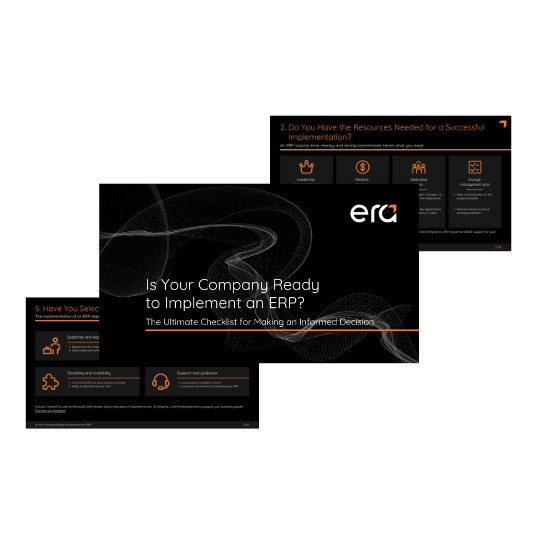
Not sure if your business isready?
Beforemovingforward, it can behelpful to understandwhereyoucurrently stand. We’ve put together a simple checklist thatletsyouquicklyidentifystrengths, gaps, and the key elements to considerbeforestarting an ERP project.
The ERAWAY Methodology: Era’s Structured Approach to ERP Delivery
When a company starts an ERP project, one question always comes up: how do we make sure this goes well? Timelines, costs, surprises, team workload… all of it can quickly become stressful.
That’s exactly why we developed our own delivery framework, the ERAWAY methodology. It’s not just a generic sequence of steps. It’s a structured, transparent, and agile way of working that helps projects move forward with far less uncertainty.
Eraway is built around four core phases, each delivered by a multidisciplinary Squad. Instead of working with isolated consultants, you work with a tight-knit team that includes functional consultants, developers, architects, business analysts, and whenever needed, AI or NextGen specialists.
And this Squad is never alone; it’s backed by our Center of Excellence, our architects, our security experts, and the wider Era ecosystem. The result is a project that moves with clarity, efficiency, and alignment.
Here’s how it works.
Phase 1
Initiation and Planning
Understand, prepare, and align. Before configuring anything, we listen. We clarify the company's direction, business goals, pain points, and constraints.
This phase includes a key step: process reengineering. We map out flows, identify redundancies, and simplify to avoid automating inefficient processes.
Documented roles and responsibilities
Approved and managed budgets
Official communication channels
Alignment on deliverables and expectations
Phase 2
Design and Architecture
Building a sustainable solution. This is where needs transform into a concrete solution. The Squad develops the ERP architecture (Microsoft Dynamics 365 Business Central or JD Edwards) and maps integrations.
When needs exceed standard features, we create clean, targeted, and scalable extensions, all validated by our architects to ensure robustness without unnecessary complexity.
Phase 3
Implementation and Validation
An ERP implementation is not just about configuration; it is a human transition. At ERAWAY, this dimension is essential.
The Squad works in iterations: configuring, migrating data, and conducting regular demonstrations. We emphasize change management and training to ensure every team understands how the new tool improves their daily work.
Phase 4
Deployment and Support
A continuing partnership. Go-Live is not the end. We coordinate the production launch, support users, and remain present to stabilize operations.
As organizations change, the ERP evolves with them. We plan for continuous improvement, adding new modules or integrating complementary tools to support strategic growth.
The strength of the ERAWAY methodology lies in its ability to combine structure, agility, governance, and multidisciplinary teamwork. For businesses, it means projects that move forward with confidence, clarity, and far fewer surprises.
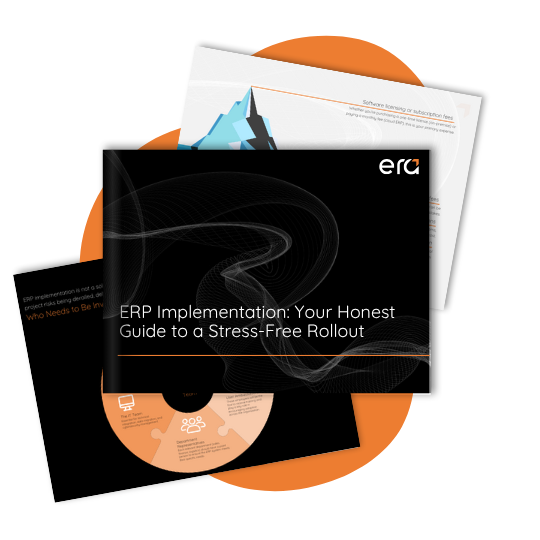
Our Complete ERP Implementation Guide
If you want to go further, explore our guide covering the key steps, common pitfalls to avoid, and the essentials you need to ensure a successful ERP implementation.
ERP Consultant or Implementation Partner? Two Roles That Are Often Confused
There’s a common mix-up we see in organizations beginning an ERP project. People look for a consultant but describe implementation work. Or they look for an implementation partner but really need guidance first. And sometimes, both terms get used as if they meant exactly the same thing. In reality, they complement each other, but they don’t play the same role.
The ERP consultant is the one who brings clarity. They analyze processes, challenge assumptions, help structure priorities, and guide decisions. It’s a hybrid between business advisor and technology strategist. Their job is to help you choose the right direction.
The implementation partner, on the other hand, turns that direction into a working solution. They configure the ERP, build integrations, migrate data, train users, and ensure the final system behaves exactly the way it should. They’re the builders who take the vision and make it real.
Both roles matter, but many projects struggle when they’re disconnected. Without strategic guidance, an implementation can become purely technical and drift away from the business needs. Without strong execution, the best analysis stays theoretical and never becomes a functioning system.
What sets Era Consulting Group apart is that these roles are not siloed. Thanks to the ERAWAY methodology, everything happens within a single multidisciplinary Squad. The strategic consultant, business analyst, developer, architect, and change specialist move together from the initial discovery phase to Go-Live. No handoffs that dilute context. No gaps between “what we planned” and “what we built.”
For businesses, that means fewer surprises, clearer communication, faster alignment, and an ERP that reflects the real operational needs of the organization.
This is why Era Consulting Group positions itself as an ERP ecosystem partner: an organization capable of advising, implementing, and evolving solutions well beyond the ERP itself.
The Real Benefits of Working With an ERP Consultant
When a company decides to modernize its ERP, the expectation is usually simple: save time, streamline operations, and finally get a clear view of what’s happening across the business. And yes, those are real outcomes. But the benefits of working with an ERP consultant go much deeper, especially when that consultant understands both business realities and the technology behind them.
Here’s what organizations tell us most often after a consulting engagement.
1. Clearer visibility and faster decision-making
An ERP consultant helps turn a cluttered environment into something structured and understandable. Data becomes consistent. Processes become simpler. Reports stop being multi-hour or multi-day projects in Excel. Suddenly, leadership can make decisions faster and with a lot more confidence.
2. A significant reduction in manual work
Duplicate entries disappear. Spreadsheets shrink. Repetitive tasks get automated. It’s not just a time saver. It’s a relief for teams who can finally shift from “pushing the system” to actually contributing value.
3. Better collaboration across departments
When sales, purchasing, finance, and operations all share the same information at the same moment, friction drops dramatically. An ERP consultant often acts as a kind of translator between teams, helping align workflows and reconnect operations that may have been drifting apart.
4. A safer and more stable ERP implementation
ERP failures rarely come from the software itself. They happen because of unclear priorities, weak governance, incomplete preparation, or misunderstood expectations.
A consultant helps keep the project grounded with:
a structured approach
well-defined priorities
realistic timelines
change management from the beginning
Less uncertainty. Less stress. Far fewer “unknowns” showing up mid-project.
5. A system that actually matches the way you work
Installing an ERP isn’t enough. It needs to reflect real-world operations: inventory movements, production workflows, costing methods, approval chains, supply-chain timing, and everything in between.
A good ERP consultant ensures the system adapts to your business rather than forcing your team to work around gaps and limitations.
6. A smoother growth trajectory
As a company grows, so does the need for a strong operational backbone. A well-designed ERP becomes the difference between struggling to keep up and actually supporting growth.
A consultant helps lay the foundation for scalability: choosing the right modules, anticipating future needs, and building an environment that won’t crumble as volume increases.
7. Higher user adoption and a more confident organization
The human side of ERP is often overlooked. A consultant doesn’t just work with the system; they work with people. They explain, support, and help employees gain confidence.
This is what turns an ERP from “another tool” into a real driver of performance.
Ultimately, the role of an ERP consultant isn’t just to modernize a system. It’s to modernize how the organization functions day to day, creating clarity, consistency, and the space teams need to perform at their best. When this expertise is paired with a structured approach like ERAWAY the benefits become even more tangible.
Why Organizations Choose Era Consulting Group for Their ERP Projects
ERP projects are never simple. They require clarity, coordination, and an understanding of how a business truly operates behind the scenes. Many firms can configure a system. Fewer can guide an organization through the strategic, operational, and human dimensions of change.
That’s where Era Consulting Group stands out.
1. More than 20 years of ERP expertise
We’ve accompanied organizations through growth, restructuration, modernization, and everything in between.
This experience matters because ERP projects rarely unfold exactly as planned. Having a partner who has seen many scenarios before helps keep the project stable and predictable.
2. Deep specialization in manufacturing and distribution
These industries have unique operational realities: inventory precision, production workflows, costing models, customer expectations, supply-chain timing. Our teams understand them in detail.
It’s why manufacturers and distributors across Eastern Canada trust us with projects that require both technical mastery and operational nuance.
We also support other sectors such as professional services, sustainability management, and finance, but our strongest footprint remains in operations-driven industries.
3. Dual expertise: Business Central for SMEs and JD Edwards for large enterprises
Most consulting firms focus on only one ecosystem.
This dual perspective allows us to recommend the platform that truly fits the business, not the one we happen to sell.
4. A real consulting-first mindset
We don’t start with modules or configuration. We start with your business model, your constraints, your ambitions, and your operations. Technology comes after.
This approach avoids rushing into decisions that feel right on paper but fall apart in practice.
5. Multidisciplinary Squads, not isolated consultants
This is one of the biggest differentiators.
With ERAWAY, each project is delivered by a Squad that blends:
functional consultants
solution architects
developers
business analysts
integration specialists
change management support
and, when required, AI and NextGen expertise
Everything moves together. No confusion, no handoffs where context is lost.
Behind the Squad, you also have Era Consulting Group’s full ecosystem: our Center of Excellence, our architects, and our security leadership. Clients feel the difference immediately.
6. Strong governance that keeps projects on track
Budgets, timelines, documentation, deliverables, communication, everything is structured. This governance not only protects the project; it protects your peace of mind.
Clients often tell us this is what reassured them the most.
7. Bilingual delivery across Canada and the United States
We serve organizations in both French and English, with teams who understand the cultural and regional differences that shape how businesses operate in North America.
Working with an ERP partner is a long-term relationship. You want a team that understands your environment, adapts to your reality, and supports your growth long after Go-Live.
And for many organizations, that’s exactly why they choose Era Consulting Group.
What Our Clients Say
At a certain point, the best way to understand the impact of an ERP consulting partnership is to hear it directly from the organizations we support. Their words reflect the quality of the relationship as much as the success of the project itself.
Here are a few testimonials from companies that trusted Era Consulting Group for strategic advisory, modernization, or implementation work.
"Thank you to our technology partner, Era Consulting Group, who supported us in implementing an ERP and eCommerce system that has given us real-time visibility across our operations and made our products accessible worldwide."
Soukeyna Aubert
Director of Operations
Waterax
How Much Does ERP Consulting Cost?
Talking about the cost of an ERP project is a bit like talking about the cost of a renovation. It depends on the size of the project, its complexity, the condition of your current systems, and the vision you have for the future.
Some organizations only need a few targeted workshops. Others require a full analysis, a tailored architecture, and a complete implementation.
That’s why there’s no universal number. But there are clear categories that help understand where you might land.
1. One-off consultations and targeted workshops
These are for businesses that need clarity before moving forward: validating a direction, mapping processes, assessing systems, or preparing for a larger transformation.
This may include:
diagnostic sessions
process mapping
technology evaluations
These engagements are short and designed to help decision-makers see their options more clearly.
2. Full analyses and ERP project preparation
When multiple departments are involved or when operations need to be reviewed in depth, the costs naturally increase. This phase is often a strategic investment because it helps avoid costly surprises later in the project.
It typically includes:
process reengineering
detailed requirements analysis
integration assessment
feasibility workshops
ERP project budgeting and planning
This is usually the stage that clarifies everything.
This is the largest scenario. It includes configuration, integrations, data migration, custom development, training, change management, and post-go-live support.
Several factors influence cost:
number of modules
operational complexity
required integrations
amount of historical data to migrate
level of custom development
size of the project team
This is where the ERAWAY methodology makes a real difference.
With strict governance, upfront clarity, and a structured delivery model, clients know exactly how costs, hours, deliverables, and adjustments will be managed throughout the project.
4. Ongoing support and system improvement
After go-live, many organizations choose continuous support. It’s flexible, adapted to your needs, and ensures your ERP evolves along with your business.
This may include:
new modules
new integrations
performance optimization
additional training
process improvements
At the end of the day, the most important point is this:
There isn’t a single price for ERP consulting, but there is a clear outcome: a structured investment that helps you avoid costly mistakes, strengthen operations, and build a system that truly supports long-term growth.
And when that investment is guided by a structured method like ERAWAY, the entire project becomes more predictable, more controlled, and far less stressful for your teams.
How to Choose the Right ERP Consultant
Choosing an ERP consultant is closer to choosing a long-term business partner, someone who will guide your teams through a major transformation. And because the stakes are high, it’s worth taking a moment to look beyond the surface.
Here are a few elements that really make a difference.
1. Look for a consultant who understands your business model, not just your ERP
A good consultant doesn’t jump straight into modules. They ask questions about your margins, production workflows, supply chain timing, inventory constraints, service commitments, or financial structure.
They connect the dots between your business reality and the system you’re trying to improve.
If the conversation feels “too technical, too fast,” that’s usually a red flag.
2. Make sure they have real experience in your industry
An ERP consultant who already knows your world will:
understand your operational constraints
anticipate pitfalls
accelerate workshops
avoid unnecessary detours
It saves time. And it reduces risk.
3. Ask about the methodology, it matters more than you think
ERP projects can fail when the delivery approach is vague.
A strong methodology brings:
structure
predictability
communication clarity
governance
That’s why ERAWAY resonates so much with our clients. They know exactly how the project will unfold, who does what, and how decisions are made.
If the consultant can’t clearly explain their method, it’s worth pausing.
4. Check how they work as a team
Some consultants work alone or pass responsibilities from one specialist to another. Others, like the Era Squads, operate as a single unit with shared accountability.
The difference is huge. A coordinated team moves faster, communicates better, and avoids the misunderstandings that slow projects down.
5. Consider their ability to support you after Go-Live
A consultant’s job isn’t finished once the system is launched.
You want someone who can:
train users
stabilize operations
answer questions quickly
recommend improvements
accompany your growth long term
ERP isn’t a short-term initiative. Neither is the relationship with your consultant.
6. Evaluate how well they listen
It sounds simple, but it’s one of the most important points.
A good ERP consultant listens more than they speak. They take the time to understand where frustration builds, where processes slow down, and what teams really need.
Technology can only solve problems that were properly identified.
In short, choosing the right ERP consultant means choosing clarity, structure, and peace of mind. When the expertise, the method, and the human connection align, the entire implantation becomes smoother, more predictable, and far more valuable for your organization.
FAQ
What exactly does an ERP consultant do?
An ERP consultant analyzes your processes, clarifies your needs, recommends the right solution, and helps structure your ERP project so it supports your business goals.
What’s the difference between an ERP consultant and an implementation partner?
A consultant provides guidance and analysis, while an implementation partner configures and deploys the system.
At Era Consulting Group, these roles work together within one multidisciplinary Squad so nothing gets lost along the way.
When should a company bring in an ERP consultant?
When systems no longer talk to each other, when manual work keeps increasing, when visibility is limited, or when you’re unsure whether to upgrade, reconfigure, or replace your ERP.
Can an ERP consultant help even if we already have an ERP?
Yes. A consultant can optimize configurations, solve inefficiencies, streamline processes, or prepare a modernization, such as moving from Dynamics NAV to Dynamics 365 Business Central.
How much does ERP consulting cost?
Costs vary depending on the scope, number of departments involved, integrations, and level of customization.
Strong governance, like the ERAWAY methodology, helps keep budgets predictable and under control.
Which ERP platforms does Era Consulting Group support?
We specialize in Microsoft Dynamics 365 Business Central for SMEs and growing organizations, and JD Edwards for large enterprises needing robust, complex capabilities.
Does Era support clients in both Canada and the United States?
Yes. Our teams provide bilingual support in French and English across Canada and the United States.
The Right ERP Consultant Can Change the Trajectory of Your Project
Modernizing an ERP or implementing a new one can feel overwhelming at first. There are many moving parts, countless decisions, and a real impact on the people who use the system every day. But with the right consultant, everything becomes clearer. The complexity turns into a structured plan, the uncertainty fades, and teams start to feel supported instead of stressed.
An ERP consultant doesn’t just configure a tool. They help you see your business differently, simplify what needs to be simplified, and build a foundation that supports your long-term growth.
With a structured methodology like ERAWAY, multidisciplinary Squads, and more than twenty years of hands-on experience across manufacturing, distribution, and other industries, Era Consulting Group brings a level of clarity, rigor, and partnership that organizations truly value.
If you’re exploring a new ERP, considering a modernization, or simply trying to better understand your options, this is often the ideal moment to speak with an expert and map out the path ahead.
Speak With an ERP Expert
Every organization has its own challenges, priorities, and pace.If you’d like to talk through your situation, evaluate your options, or get a clearer sense of direction, our ERP experts are here to help.
Oussama is a technology content expert at Era Consulting Group. He focuses on making complex topics related to ERP and enterprise technologies accessible, helping organizations fully leverage digital innovations. He brings several years of experience in the SaaS and technology industries, notably with companies such as Zoho and ManageEngine.