
Choosing the Right APS: Why So Many Projects Fail

Oussama Nait-Zlay
Content Marketing Manager
February 25, 2026
We don’t talk about it often, but it’s true.
Many APS projects never deliver the results companies expect. Not because the technology is weak. Not because the vendor lacks capability. But because the level of sophistication chosen doesn’t match the organization’s actual operational maturity.
And that changes everything.
An APS system is attractive. Simulation. Optimization. Finite capacity planning. Scenario modeling. On paper, it looks powerful. In demos, it’s impressive. But a plant that still relies heavily on spreadsheets, imperfect data, and unstable processes doesn’t have the same needs as a structured multi-site industrial group with disciplined workflows.
We often confuse ambition with readiness.
Companies want the most powerful system. The most complete one. The one that “does everything.” Yet an overly advanced APS can quickly become counterproductive. Heavy configuration. Difficult adoption. Internal resistance. The project loses momentum. Gradually, it slips into survival mode.
It’s a bit like installing a Formula 1 engine in a city car. Impressive, yes. Appropriate? Not necessarily.
Choosing the right APS is about selecting the one that fits your current operational maturity while leaving room to evolve over time.
And that’s where the conversation gets interesting.
TL;DR
Choosing the right APS isn’t about selecting the most sophisticated solution, but the one that truly matches your organization’s operational maturity.
- An APS that’s too advanced can slow a project down if data and processes aren’t stabilized.
- There are several maturity levels: visibility, finite capacity, optimization, and industrial complexity.
- Finite capacity planning requires reliable data and strong operational discipline.
- With Dynamics 365 Business Central, organizations can evolve progressively without a major technological disruption.
APS Is Not a Single, Uniform Tool
We often refer to “an APS” as if it were one clearly defined category. One standard type of solution.
It isn’t.
There’s a significant gap between a simple visual scheduling tool and a sophisticated optimization engine powered by advanced algorithms. And that gap has real consequences for project success.
Infinite Capacity vs. Finite Capacity… It Matters
Let’s start with the fundamentals.
Infinite capacity planning assumes that resources can absorb the planned workload without real constraints. Production orders are scheduled, and adjustments are made manually when conflicts appear. It’s straightforward. Fast. Often sufficient for less complex environments.
Finite capacity planning works differently. It accounts for real-world limits: machines, labor availability, bottlenecks, shift calendars. The system calculates a schedule based on actual constraints and produces a more realistic production plan.
It sounds obvious when explained this way.
But introducing finite capacity requires clean data, reliable routing times, and operational discipline. Without that foundation, the system generates theoretical schedules that shop-floor reality constantly overrides.
And suddenly, planners are back to manual adjustments.
Visualization or Optimization?
Another major difference lies in approach.
Some APS solutions prioritize visibility. Intuitive Gantt charts. Drag-and-drop scheduling. Quick rescheduling. The planner stays in control.
Others focus on algorithmic optimization. The system runs simulations, evaluates scenarios, and calculates the “best” sequence based on defined objectives such as throughput, lead time, or resource efficiency.
Both approaches have value.
But a company that hasn’t yet stabilized its processes doesn’t necessarily need an advanced optimization engine. It often needs visibility first. Clarity. A structured way for planners and production teams to align around a shared schedule.
It’s like installing predictive GPS software when your map isn’t even up to date.
Sophistication isn’t the issue. Misalignment is.
And that’s exactly why maturity levels matter.
The 4 APS Maturity Levels: Where Does Your Organization Stand?
Every manufacturing company wants better planning. That’s not surprising. Lead times are tightening. Cost pressure is constant. Customers expect flexibility and reliability at the same time.
But not every organization is at the same stage.
Here’s a simple way to position APS solutions based on operational maturity.
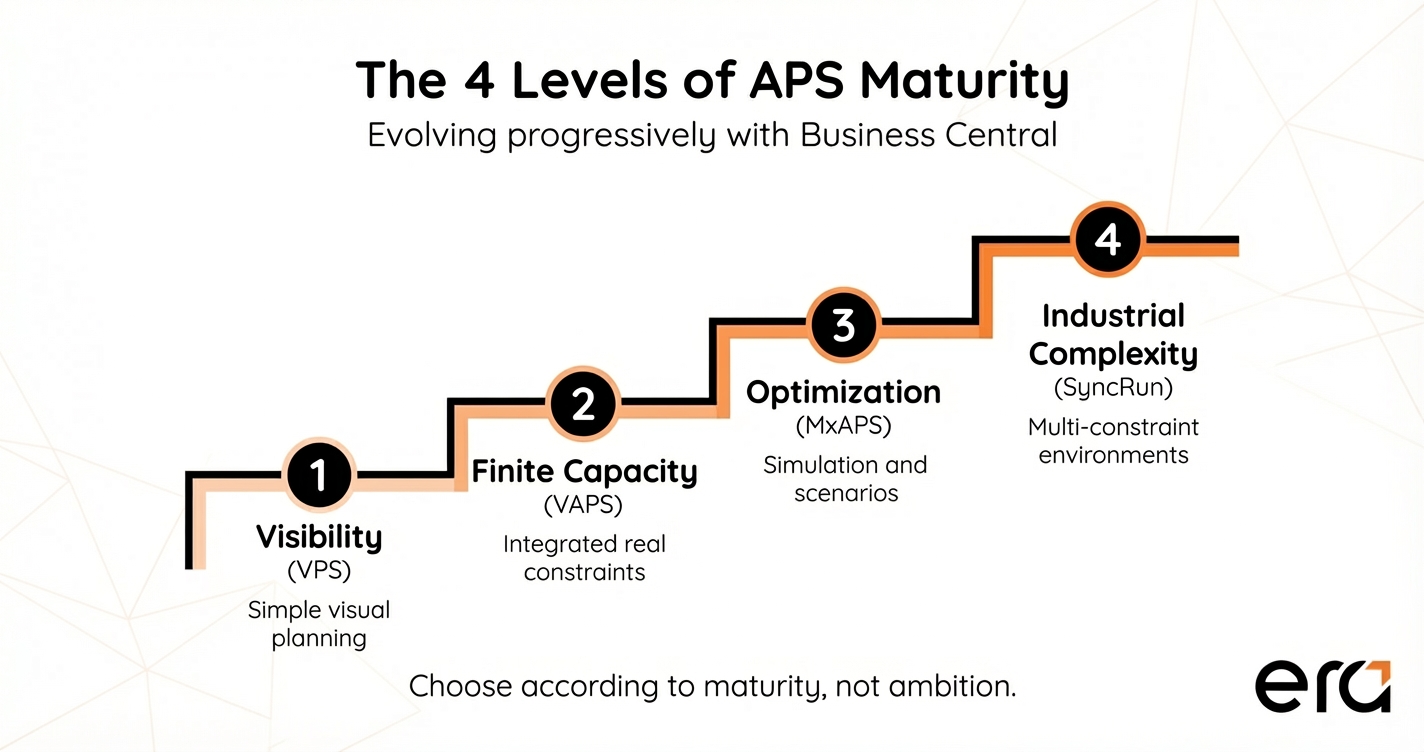
Level 1: Visibility First
At this stage, planning often relies on a mix of ERP outputs and spreadsheets. The data exists, but there’s limited global visibility. Capacity conflicts are discovered… usually too late.
The goal isn’t advanced optimization yet. It’s clarity.
Solutions like VPS from Netronic fit this level. Integrated directly into Microsoft Dynamics 365 Business Central, it provides visual scheduling with Gantt charts and drag-and-drop functionality using infinite capacity logic.
Fast to implement. Intuitive. Lower complexity.
Does it solve every capacity issue? No.
But it structures the conversation. It professionalizes planning. And for many organizations, that’s the necessary first step.
Level 2: Capacity Becomes Real
At this stage, constraints start to hurt.
Machines are overloaded. Teams are stretched. Delays are recurring. Planning “in theory” no longer works.
This is where finite capacity planning becomes essential. Resources are modeled. Calendars are respected. The system schedules within real operational limits.
VAPS from Netronic builds on this logic. Still integrated with Microsoft Dynamics 365 Business Central, it introduces true finite capacity planning and more advanced simulation capabilities.
Automation increases. Complexity increases too.
And that’s normal.
At this level, the organization is ready to invest in data accuracy and planner training. Without that discipline, finite capacity can feel restrictive rather than helpful.
Level 3: Optimize, Simulate, Compare
Some companies go further. They don’t just want realistic schedules. They want optimized ones.
Multiple scenarios. Trade-offs between cost and lead time. Multi-resource balancing.
Solutions like MxAPS from Insight Works, also connected to Microsoft Dynamics 365 Business Central, introduce optimization algorithms and more advanced finite capacity logic.
It’s powerful. Flexible. Often a strong balance between performance and complexity.
But here’s the nuance.
If foundational data is unstable, optimization becomes theoretical. The system calculates the “best” schedule, and planners manually adjust it anyway.
Without operational discipline, even sophisticated tools struggle to deliver their full value.
Level 4: Advanced Industrial Complexity
At the highest maturity level, organizations operate in highly complex environments: multi-site operations, interdependent production lines, tight logistics constraints, performance KPIs monitored daily.
Here, specialized tools like SyncRun from SyncForce come into play.
Finite capacity planning is combined with advanced algorithms and scenario modeling. The potential impact is significant. But implementation requires deeper integration with Microsoft Dynamics 365 Business Central, along with strong governance and investment.
This isn’t about better or worse.
It’s about fit.
The Real Question Isn’t “Which One Is Best?”
The real question is simpler.
Is your organization ready for the next level?
An APS that’s too simple can limit growth. An APS that’s too sophisticated can slow transformation.
Sometimes, the smartest strategic move isn’t to jump to the most advanced tool. It’s to select the right step and evolve progressively.
And that’s where the Business Central ecosystem becomes particularly interesting.
Perfect. Let’s connect the strategy to the platform.
Why Business Central Changes the Game
Here’s something we see often.
In many ERP environments, moving to a more advanced APS solution almost feels like launching a separate transformation project. New platform. Heavy integration work. Parallel systems.
Planning becomes a project on its own.
With Microsoft Dynamics 365 Business Central, the dynamic is different.
Solutions such as VPS and VAPS from Netronic, or MxAPS from Insight Works, are designed as natural extensions of the ERP. They share the same data model. They operate within the same environment. They reduce duplication and eliminate disconnected databases.
That’s not a small detail.
Evolve Without Rebuilding Everything
One of the most strategic advantages of the Business Central ecosystem is progression.
You can start with visual planning. Stabilize your data. Train your teams. Structure your processes.
Then, when the organization is ready, introduce finite capacity. Add simulation. Refine scheduling rules.
This isn’t a disruptive leap. It’s controlled evolution.
It’s similar to building athletic performance. You don’t begin with complex tactical systems if the fundamentals aren’t strong. You build discipline first. Then sophistication.
APS maturity follows the same logic.
Reducing Risk, Not Just Improving Performance
Many companies approach APS with one goal in mind: improve productivity.
That matters. But there’s another dimension that’s often overlooked.
Project risk.
An APS that integrates cleanly with your ERP, evolves gradually, and aligns with your operational maturity significantly lowers implementation risk.
Fewer fragile interfaces. Fewer custom developments. Fewer moving parts.
Does that make it effortless? No.
But it makes it predictable. And in manufacturing, predictability often matters just as much as optimization.
Which leads to a strategic reflection.
Do you want the most impressive APS on paper?
Or do you want one that your planners actually use, trust, and rely on every day?
There’s a difference.
Perfect. Let’s bring it home with a practical, decision-focused section.
How to Choose the Right APS Based on Your Organizational Maturity
We could give you a detailed feature comparison. Line-by-line functionality. Algorithm types. Technical architecture.
But that’s not the right starting point.
The real question is simpler. And more strategic.
Is your organization ready to leverage the level of sophistication you’re considering?
Because an APS doesn’t fix a disorganized operation. It amplifies what’s already there.
If your data is inaccurate, the system will generate inaccurate plans.
If your processes are unstable, the schedule will reflect that instability.
If roles and responsibilities are unclear, no algorithm will clarify them for you.
A strong APS rests on strong foundations.
A Few Honest Questions to Ask
Here’s a simple diagnostic to consider:
- Are your routing times reliable and regularly maintained?
- Are resource calendars clearly defined?
- Is production feedback consistently confirmed and accurate?
- Do planners follow a structured method, or rely heavily on manual adjustments?
- Is leadership prepared to invest in data governance and discipline?
If several of these questions raise concerns, that’s not a failure. It’s insight.
Maybe the priority isn’t advanced optimization yet.
Maybe the priority is visibility and stabilization.
And that’s completely legitimate.
The Trap of Premature Sophistication
It’s tempting to jump straight to the most advanced planning solution. Advanced algorithms. Complex simulations. Detailed performance indicators.
Strategically, it sounds ambitious.
But if shop-floor teams haven’t fully adopted even basic visual planning tools, the transition becomes heavy. The screens look impressive, yet daily usage remains hesitant.
Initial excitement fades. The tool becomes underutilized. Manual adjustments creep back in.
That’s not a technology problem. It’s a pacing problem.
A Logical Progression
A more sustainable path often looks like this:
Start by structuring visual planning.
Stabilize the data.
Train the teams.
Measure tangible improvements.
Then, introduce finite capacity.
Then, optimization.
That approach isn’t less ambitious. It’s more strategic.
Because a well-chosen APS doesn’t just improve schedules. It improves collaboration between planning and production. It builds discipline. It strengthens operational confidence.
And that’s often where the real value lies.
Choose Based on Reality
There is no universally “best” APS.
There is the right level for your organization today.
Some companies need better visibility.
Others need to manage real capacity constraints.
Some are ready for advanced optimization in complex environments.
The key isn’t maximum sophistication.
The key is fit.
With Microsoft Dynamics 365 Business Central, it’s possible to evolve progressively, without a disruptive platform shift.
And that gradual evolution is often what separates a project that stalls… from one that becomes embedded in daily operations.
So the question isn’t:
Which APS is the most advanced?
It’s:
Which level truly matches our current maturity?
If you’d like to evaluate where your organization stands and define a realistic roadmap, our team can help structure that conversation.
Because choosing the right APS always starts with understanding your own operational foundation.

Is your APS maturity ready for the next level?
We help manufacturers assess their operational foundations and define a realistic planning roadmap before making any technology decisions.
Evaluate Your Current Planning MaturityFAQ
What is an APS in manufacturing?
An APS (Advanced Planning and Scheduling) system is a production planning tool that schedules operations based on real resource constraints such as machines, labor, and calendars. It goes beyond traditional MRP by incorporating capacity management and, in some cases, optimization algorithms.
What is the difference between infinite and finite capacity planning?
Infinite capacity planning schedules work without considering real resource limits, requiring manual adjustments later. Finite capacity planning schedules based on actual constraints, producing more realistic plans but requiring accurate operational data.
Why do APS projects fail?
APS projects often fail due to a mismatch between system complexity and organizational maturity. If data accuracy, routing reliability, or operational discipline are weak, even advanced planning tools may be underutilized.
Does Microsoft Dynamics 365 Business Central include an APS?
Microsoft Dynamics 365 Business Central includes basic MRP functionality. For advanced scheduling, Gantt visualization, finite capacity, or optimization, companies typically use integrated extensions such as those from Netronic or Insight Works.
Can you implement APS without an ERP?
Technically yes, but in practice APS relies on ERP data such as bills of materials, routings, inventory, and production orders. Most APS solutions are implemented as extensions of an existing ERP system.
Can companies evolve toward a more advanced APS over time?
Yes. Within the Business Central ecosystem, companies can start with visual scheduling and progressively introduce finite capacity and optimization features as operational maturity increases.
Oussama Nait-Zlay
Content Marketing Manager
Oussama is a technology content expert at Era Consulting Group. He focuses on making complex topics related to ERP and enterprise technologies accessible, helping organizations fully leverage digital innovations. He brings several years of experience in the SaaS and technology industries, notably with companies such as Zoho and ManageEngine.
Follow Oussama Nait-Zlay
Featured