
What Is Microsoft Dynamics 365 Business Central?

Oussama Nait-Zlay
Content Marketing Manager
Published on February 27, 2026
Updated in April 2026
There is a turning point in the life of every growing SMB.
Revenue increases. The team expands. Operations become more complex. What worked well at 20 employees starts showing strain at 50 or 100.
Financial reports take longer to produce. Inventory numbers do not always align. Strategic decisions require manual consolidations. Nothing is broken exactly. But something feels stretched.
This is usually when leadership starts asking a simple question:
Do we still have the right systems to support our growth?
That is when Microsoft Dynamics 365 Business Central often enters the conversation.
Because executives are looking for visibility. Control. Structure. A single source of truth across the organization.
Before we talk about features, we need to understand why this solution is gaining attention among Canadian SMBs.
So what exactly is Business Central?
And more importantly, when does it become relevant for a growing business?
Let’s clarify.
What Is Business Central, Exactly?
Microsoft Dynamics 365 Business Central is an enterprise resource planning system, commonly referred to as an ERP.
But instead of stopping at the acronym, let’s break it down.
An ERP is a centralized business management system that connects the core functions of a company into one unified platform. Rather than using separate tools for accounting, inventory, sales, and purchasing, everything operates within the same environment.
In the case of Business Central, financial data, purchasing, sales, inventory, and operational workflows all share a single database.
What does that mean in practice?
- A customer order automatically updates inventory levels
- Costs and margins are calculated in real time
- Financial reports reflect operational activity without manual consolidation
- Dashboards provide immediate visibility into performance
For a CFO, that means fewer discrepancies between reports and reality.
For a COO, it means smoother operational coordination.
For a CEO, it means making decisions based on consistent, reliable data.
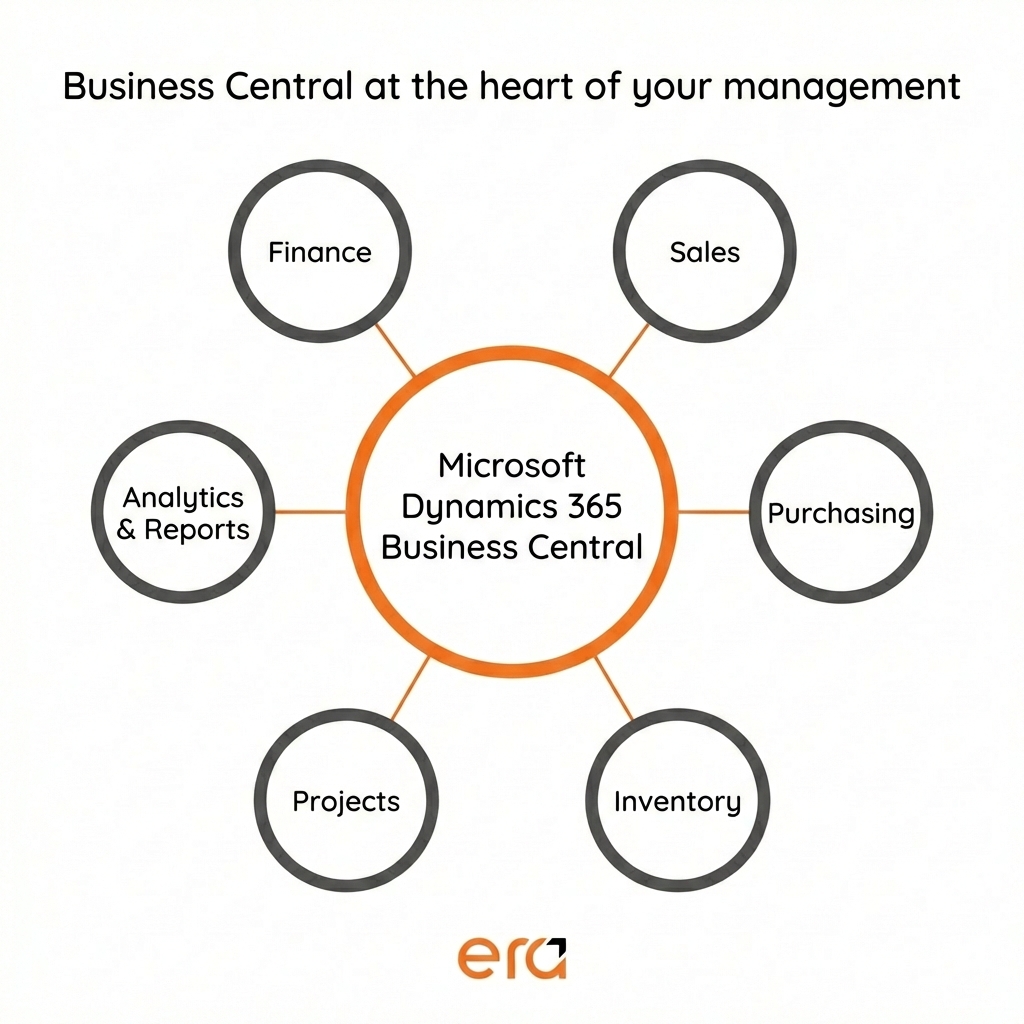
Business Central is a cloud-based ERP developed by Microsoft. It integrates seamlessly with Microsoft 365, Power BI, Outlook, and Teams. For SMBs already operating within the Microsoft ecosystem, that continuity reduces friction and accelerates adoption.
But there is something more important to understand.
Business Central is not simply a software tool. It is a management framework. It introduces structure across departments. It connects financial and operational flows. It creates one version of the truth.
And that structural foundation is often what allows a growing business to scale without losing control.
Why Is It Called an ERP and Not Just Software?
The term ERP can sound technical. But at its core, it describes something very practical.
Most software applications solve a specific problem. Accounting software manages transactions. Inventory tools track stock. CRM systems support sales teams. Each does its job well. But often, they operate independently.
An ERP system does something different.
It organizes the entire business.
This is not just about features. It is about architecture. An ERP connects departments. It aligns financial data with operational activity. It creates a shared structure across the organization.
For a growing SMB, that distinction becomes critical.
Consider a simple scenario.
If sales increase by 20 percent:
- Does inventory adjust accordingly?
- Are margins calculated accurately?
- Can cash flow absorb the pressure?
- Is production aligned with demand?
In a fragmented system environment, answering those questions takes time. Data must be pulled from multiple sources. Numbers may conflict. Decisions get delayed.
An ERP like Business Central reduces that fragmentation. It standardizes processes. It connects financial and operational flows. It ensures that data tells a consistent story across the company.
At a certain stage of growth, leaders often realize something important.
The challenge is no longer technological. It is organizational.
Implementing an ERP is not about adding another tool. It is about professionalizing how the business operates.
For many Canadian SMBs, this moment comes after years of organic growth. The patchwork systems worked… until they didn’t.
Moving to an ERP usually signals a new phase. More structure. Greater control. Stronger foundations for expansion.
Considering an ERP Requires a Clear Methodology
The success of an ERP project does not depend solely on selecting the right software. It depends on preparation, governance, and structured execution. Our ERP Implementation Guide outlines the key phases, common risks, and critical success factors for SMBs.
Download the ERP Implementation GuideWhat Does Business Central Actually Enable in a Growing SMB?
As an SMB grows, complexity rarely appears in one place. It spreads. Across processes. Across systems. Across decisions.
That is where Business Central becomes valuable.
First, it delivers real-time financial visibility.
Leadership no longer needs to wait for month-end reports to understand performance. Margins, cash flow, outstanding payables, receivables, sales activity, and inventory levels are all connected within the same system. The numbers reflect operational reality.
Second, it structures day-to-day operations.
A customer order automatically updates inventory. Purchasing can be planned based on actual demand. Costs are tracked with precision. Projects link directly to financial results.
That direct connection between operations and finance changes how teams work. Departments no longer operate in parallel silos. They work from the same dataset.
Another often overlooked capability is analytics.
With built-in dashboards and integration with Power BI, executive teams can monitor key performance indicators without relying on manual spreadsheet consolidations. Data becomes a decision-making tool rather than a historical record.
Then there is growth.
Adding a new entity. Managing multiple currencies. Expanding into new provinces or regions. Consolidating subsidiaries. These transitions are easier when supported by a centralized ERP structure.
Business Central does not eliminate complexity. But it creates a framework to manage it.
Ultimately, it enables a shift from reactive management to controlled growth.
And for executive leadership, that shift makes all the difference.
Who Is Business Central Designed For?
Business Central is not intended for every company. And it is important to say that clearly.
A startup in its early stages, with limited transactions and simple processes, may not need a full ERP system. At that level, complexity has not yet reached a critical threshold.
But as an SMB grows, its needs evolve.
Business Central is typically relevant for organizations that:
- Manage an increasing volume of transactions
- Operate across multiple departments that depend on shared data
- Handle inventory, production, or project-based operations
- Work across provinces, currencies, or legal entities
- Require consolidated financial visibility to guide growth
This is not strictly about company size. It is about operational complexity.
A 25-person company with structured operations may already feel the strain of disconnected systems. Meanwhile, a larger but simpler organization may not face the same pressure yet.
The leadership teams that begin exploring Business Central often share similar priorities. They are looking for:
- Reliable financial data without delays
- Stronger coordination between finance and operations
- A scalable structure that supports expansion
- A stable foundation for long-term strategic planning
Most importantly, they recognize that their current systems are approaching their limits.
For many Canadian SMBs expanding regionally or nationally, growth brings opportunity. It also brings complexity. And that complexity demands a management framework that can support the next stage of development.
Business Central is designed for businesses that are not simply replacing software, but strengthening their operational backbone.
Perfect. Now we localize strategically for Canada. Keep it grounded. Keep it executive.
Why Are Canadian SMBs Showing Increased Interest in Business Central?
The business environment in Canada has evolved significantly over the past few years.
Margins are tighter. Supply chain volatility remains a factor. Labour shortages continue to pressure operations. Growth, when it comes, often introduces new regulatory and financial complexity.
In this environment, management systems become a strategic lever.
Executives cannot afford blind spots. They need clarity on:
- Where margins truly stand
- Which products or services drive profitability
- How cash flow is trending
- Where operational inefficiencies are emerging
And they need that clarity without layering more disconnected systems on top of each other.
Many Canadian SMBs operate with a mix of tools accumulated over time. A financial system here. An inventory solution there. Spreadsheets bridging the gaps.
This structure may function for years. But as the business scales, it becomes fragile.
Business Central attracts attention because it offers a centralized ERP framework built to support Canadian requirements. Multi-currency capabilities. Multi-entity consolidation. Compliance with Canadian financial and tax structures.
It also integrates naturally with the Microsoft ecosystem already embedded in many Canadian businesses.
But beyond the technology, there is a broader shift.
Leadership teams are looking for stability in uncertain conditions. They want systems that support growth without adding friction. They want structure that enables expansion rather than reacting to it.
That balance between control and growth is what drives increasing interest in ERP platforms like Business Central across Canada.
Is It the Right Time to Consider an ERP?
The question is not whether Business Central is a strong platform.
The real question is whether your organization has reached a stage where an integrated management structure becomes necessary.
Certain patterns tend to appear.
Monthly reports take longer to close.
Teams spend hours reconciling spreadsheets.
Executive decisions rely on numbers that require validation.
Inventory and financial data tell slightly different stories.
Growth introduces more friction than clarity.
These are not crises. They are signals.
Many SMBs operate this way for years. And it works. Until expansion, acquisition, or a spike in demand exposes the limitations of the current system.
An ERP becomes relevant when manual workarounds start costing more than structural improvement.
This is not an impulsive decision. It is a maturity decision.
Leadership teams exploring Business Central are not simply shopping for software. They are evaluating the foundation that will support the next phase of growth. A system capable of scaling without needing replacement at every milestone.
Sometimes, the right moment is simply when leadership recognizes that complexity can no longer be managed through incremental fixes.

Are You Truly Ready for an ERP Project?
Before launching a structured transformation, it is critical to assess your organization’s readiness objectively. Our ERP Readiness Checklist helps leadership teams evaluate key indicators, identify structural gaps, and determine whether the timing is right to move forward.
Download the ERP ReadinessMore Than Software. A Structure for Growth.
Microsoft Dynamics 365 Business Central is not simply another business application.
It responds to a reality many growing SMBs quietly face: growth introduces complexity. And complexity eventually demands stronger structure.
An ERP like Business Central does not solve every challenge overnight. It does not replace leadership judgment. It does not compensate for a flawed business model.
But it does provide something essential.
A unified source of data.
Clear financial visibility.
Connected operational processes.
A framework capable of supporting expansion.
For Canadian SMBs entering a new phase of growth, the conversation often shifts.
The question is no longer, “Can we continue with what we have?”
It becomes, “Can our current structure support what we are trying to build?”
That is when the ERP discussion moves from optional to strategic.
Structuring today protects tomorrow’s growth.
What is Microsoft Dynamics 365 Business Central?
Microsoft Dynamics 365 Business Central is a cloud-based ERP system designed for small and mid-sized businesses. It centralizes financial management, sales, purchasing, inventory, and operational processes within a single integrated platform, providing real-time visibility across the organization.
What is the difference between Business Central and accounting software?
Accounting software focuses primarily on financial transactions and reporting. Business Central, as an ERP system, connects financial data with operations, inventory, sales, and projects. It structures the entire business rather than managing accounting alone.
At what company size does Business Central become relevant?
There is no fixed employee threshold. Business Central becomes relevant when operational complexity increases. This may include higher transaction volumes, inventory management requirements, multi-entity structures, rapid growth, or the need for consolidated financial visibility. It is more about organizational maturity than company size.
Is Business Central suitable for Canadian SMBs?
Yes. Business Central supports multi-currency management, multi-entity consolidation, and Canadian tax and financial reporting requirements. It is widely adopted by Canadian SMBs seeking stronger operational and financial integration.
Is Business Central a cloud solution?
Yes. Business Central is hosted on Microsoft Azure and delivered as a cloud-based ERP platform. It provides secure remote access, automatic updates, and reduced infrastructure maintenance compared to on-premises systems.
How much does Microsoft Dynamics 365 Business Central cost?
The cost depends on the number of users, licensing structure, required modules, and implementation scope. For most SMBs, it is evaluated as a long-term investment that improves operational efficiency, financial visibility, and scalability.
Oussama Nait-Zlay
Content Marketing Manager
Oussama is a technology content expert at Era Consulting Group. He focuses on making complex topics related to ERP and enterprise technologies accessible, helping organizations fully leverage digital innovations. He brings several years of experience in the SaaS and technology industries, notably with companies such as Zoho and ManageEngine.
Follow Oussama Nait-Zlay
Featured